
Laminitis recovery – rehabilitating a collapsed foot
Updated: Jun 25
Equine Podiatrist: Helen Stowell
Horse: Welsh Section C mare
Background: After a yard move from one side of the country to the other, the owner had been unable to get consistent hoof care for this mare. The mare had history of both excess weight and laminitis from a previous loan home, so her diet and bloods were already being monitored prior to the first trim appointment and she’d been prescribed ertufliglozin with good results (an initial insulin reading of 300 had been reduced to 98 by Oct 2024).
The feet became very overgrown and despite best efforts, the owner was unable to get the regular hoofcare that the mare needed from her new yard. So the owner made the switch to a more local EP.
First trim December 2024: At the first trim appointment it was obvious that the feet were both laminitic and overgrown. There was very little vertical height to the feet. The perimeter of the sole was bulging below the level of the white line and the walls were collapsing forward and out. The assessment was that P3 was sitting very low in the hoof capsule and the sole was vulnerable. The excess toe was hampering the mare’s movement and she was uncomfortable on hard surfaces. We'll focus on the right fore, and how it has changed over the year.
 |  |  |
It was decided to trim every 3 weeks, trimming to bring the hoof walls back in, whilst leaving as much height as possible, so her soles had some relief. She was yarded on woodchip surface, fed soaked hay and a small hard feed.
February 2025 blood results: By the February her blood results returned a surprisingly high insulin reading of 231 despite her management. So the hard feed was re-examined and it was decided to cut out the balancer as it had a number of potentially unhelpful ingredients.
March 2025 trim: The walls were starting to recover some weight bearing capability. The toe was still producing laminar wedge and sole, whilst less prolapsed, was still stretched thin and showing signs of being under excess pressure. The trim was applied to keep a rim of height around the perimeter of sole, whilst controlling the length and flare of the walls. By this stage she’d rediscovered her movement and was trotting / cantering her wood chip yard with typical Welshie flash!
 |  |  |
By April blood tests confirmed we were back on track, with the insulin now down to 52.2, a remarkable improvement.
The summer was very dry, with hardly any rain from March till September. So in the early part of the summer especially, we had to manage ground and surfaces carefully as the ground hardened quickly whilst her soles were still vulnerable.
Again the bloods continued on the correct track, by 1st July 2025 her insulin was down to 17.3 – within normal range.
As the summer progressed and her comfort improved, she rejoined her herd, living out on a packed mud surface. Unbooted /barefoot and comfortable. The trim cycle was lengthened to 4/5 weeks.
Happily, by the end of the summer we could see that the walls had both strengthened and straightened. The concavity of the sole returned – indicating that P3 was better suspended in the hoof capsule. The frog structure and function improved. The growth rings were growing out, and notably the breakover of the toe was now sustaining itself.
Had the firmer ground helped the hoof capsule restore its function?
 |  | 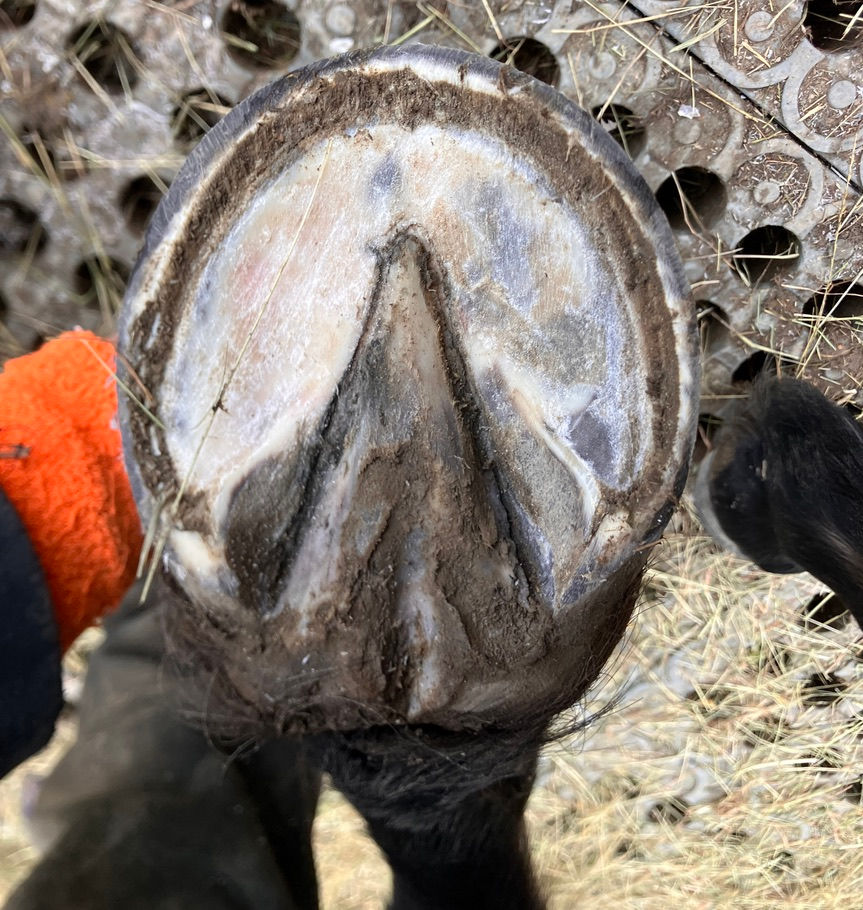 |
The last set of photos is her November post trim compared to the previous year’s trim. About three weeks short of 1 year’s progress. The mare has grown out one hoof capsule.
 |  |  |
| |  |
The mare has now been given the all clear to start in hand and light ridden work.

Comments