
Laminitis rehabilitation: overgrown hooves and Equine Metabolic Syndrome

Equine Podiatrist: Harlé Knights
Background: This pony had been suffering with laminitis, which became more apparent after a previous trim left him very sore. Understandably, his owner became worried about having his feet trimmed again for fear of causing further discomfort. As a result, his hooves had become considerably overgrown by the time of Harlé's first visit.
Harlé first saw him in late December 2025. His hooves were significantly overgrown and, combined with the changes associated with laminitis, this made it difficult to rely on the usual external landmarks when assessing and balancing the feet.
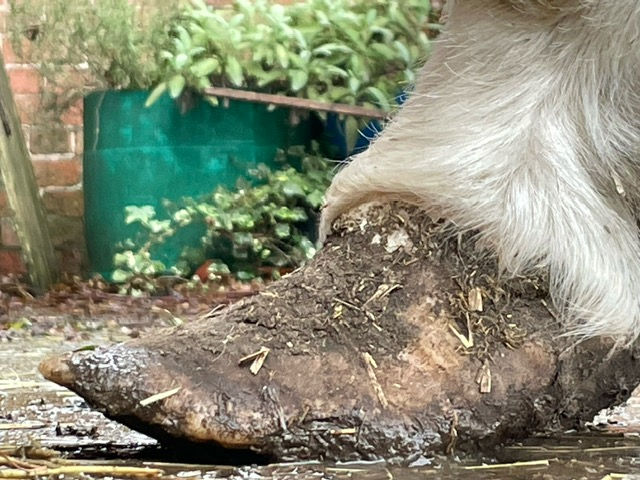

There were no radiographs available at this stage, so Harlé took a particularly cautious approach during the first few visits. The pony was put onto a three-week trimming cycle, allowing small and regular adjustments to be made while beginning to address the distortion.
Laminitic horses can alter the way they load their feet in response to discomfort, which can contribute to changes in hoof growth and balance. In this case, there was considerable excess heel growth that needed to be addressed gradually.


During this initial period, the pony was blood tested and subsequently diagnosed by his vet with Equine Metabolic Syndrome (EMS). Veterinary treatment was started and, once the appropriate medication had been established, Harlé noticed a significant change in his overall body shape.
Although he had not appeared generally overweight, he had previously carried a number of unusual areas of swelling or fat deposition. These reduced considerably following veterinary treatment.
His front feet were relatively straightforward to manage. The approach involved gradually bringing the toe back to improve breakover and reduce leverage, while carefully lowering excessive heel growth.
Changes were made conservatively, with Harlé regularly checking the pony's comfort and response, particularly during the early stages when heel growth remained substantial.


The hind feet presented a greater challenge. Without radiographs, it was not possible to determine precisely how P3 was positioned within the hoof capsule.
The appearance of the white line and the pattern of distortion raised concerns that there could also be a mediolateral component to the displacement, in addition to the dorsal rotation commonly associated with laminitis. However, without radiographs this could not be confirmed. Radiography is normally used to assess the position and displacement of P3 in chronic laminitis.
This meant progress had to be carefully assessed at each visit. Harlé watched the pony walk following each trim and made only minimal adjustments where necessary, assessing his landings and using a range of balancing techniques to support his rehabilitation.


Nine months later, some distortion remains, but the hooves are considerably closer to a more functional shape.
Most importantly, there has been a substantial improvement in the pony's comfort and movement. He is now able to trot happily for gait analysis before and after trimming, a considerable change from the pony Harlé first met, who was struggling to walk comfortably.


Comments